


Helmet rules can feel like alphabet soup. AS/NZS 2063, EN 1078, CPSC, ASTM… what do they mean, and what should Australian riders actually look for?
Here is the short version: Australian road rules can recognise more than one approved bicycle-helmet standard, depending on your state or territory and how the helmet is being used. That does not mean every helmet is automatically legal everywhere. The identifying label on the helmet still matters, and local rules should always be checked.
Australian jurisdictions have been updating the way they describe approved bicycle helmets. In Queensland, for example, approved helmets may comply with recognised standards including AS 2063, AS/NZS 2063, EN 1078, CPSC 16, ASTM F1447 and Snell B-95. New South Wales also lists several accepted standards, including AS/NZS 2063, EN 1078, CPSC 16, ASTM F1447 and Snell B-95.
The important point is that “approved” is not limited to one piece of wording printed on a product page. The accepted standard, the helmet label and the local road rule all work together. If you are riding in Australia, check the requirements for your state or territory before buying or riding.
See Queensland’s current bicycle helmet guidance or read the NSW helmet-standard update.
Look inside the helmet, on the chin strap or on the exterior for a durable label or sticker that identifies the standard the helmet complies with. The exact layout varies between standards and manufacturers. Do not rely on a generic safety logo, a marketing sticker or a product photo alone.
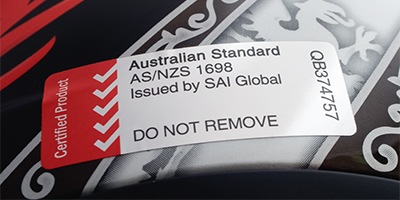
For bicycle riding, Queensland currently lists AS 2063, AS/NZS 2063, EN 1078, CPSC 16, ASTM F1447 and Snell B-95 as approved bicycle-helmet standards. NSW lists its own approved Australian and overseas standards. Always check the current rules where you ride.
Current S1 helmets sold in Australia no longer carry the Australian Standard certification mark used on earlier product versions. That change in marking does not mean the helmet’s construction or quality has changed. The S1 design still centres on the features riders choose it for: Fusion Foam, a comfortable adjustable liner system and multi-impact protection designed for repeated everyday knocks.
Different helmet standards measure different things, and a certification mark should never be treated as a complete description of a helmet’s performance. When comparing helmets, look at the whole design: the foam system, shell construction, fit, coverage, liner, retention system and the standard shown on the helmet label.
Many traditional helmets are designed around a single major impact. S1 helmets use Fusion Foam, a dual-density foam system designed for multi-impact protection. That means the design is intended to help manage more than one impact, rather than treating the first impact as the end of the helmet’s useful protection.
No helmet is indestructible. Replace a helmet after a serious impact, and inspect it regularly for cracks, crushed foam, damaged straps or a liner that no longer holds its shape. But for riders who skate, scooter, BMX, cruise or ride every day, multi-impact design is an important difference to understand.
Not sure where to start? Use the S1 helmet sizing guide, then compare the full S1 helmet range.
Helmet certification rules are evolving, and accepted standards can vary between Australian jurisdictions. The absence of one familiar mark should not be confused with a change to the underlying S1 helmet design. Check the label, check your local rules, choose a helmet that fits properly and look beyond the sticker at the technology inside.
That is where S1 is different: Fusion Foam and multi-impact protection are part of the helmet design, not just a line in a product description.
Images: Queensland Government helmet-labelling guidance. Information is general and not legal advice; check the current rules for your state or territory.
S1 Helmets Australia · Have your say
We want to make helmets in the colours you want. Pick your favourite, cast your vote and help shape a future S1 Lifer Helmet colourway.
See the current colourway rankings and vote percentages, updated as votes come in.
One vote per email address. Have another colour in mind? You can suggest your own on the voting page.
